
AI BASICS
How does AI actually work? — the complete guide for UK small businesses
You keep hearing about AI. ChatGPT. Generative AI. Large language models. AI agents. Machine learning.
It can sound complicated very quickly. It doesn’t need to be.
You don’t need to become an AI expert. You need to understand what these systems actually do, what they don’t do, and where things can go wrong.
This is the complete guide. It covers everything you need to know in plain English. No maths. No technical training. No sales pitch.
The short answer
Most of the AI you’ll come across is a large language model: software trained on huge amounts of text—and increasingly images, audio and video—that predicts what should come next. That’s why it can write, summarise and answer questions convincingly. It doesn’t know facts the way a person does. It doesn’t check its own work. And it can sound completely confident while being completely wrong.
Useful, but only if you understand what it’s actually doing.
We’ll send a password for the resource area and regular UK-focused AI updates. Unsubscribe anytime.
What is AI, really?
“AI” isn’t one thing. It’s a label that gets stuck on everything from the spell-checker in your email to the chatbot on a competitor’s website.
For a small business, almost everything you’ll encounter falls into one of three buckets:
- Predictive AI — spots patterns to forecast something. Which customers might cancel. What stock to order.
- Generative AI — creates new content. Text, images, code, video. This is ChatGPT, Copilot, Gemini.
- Agentic AI — takes actions on your behalf. It can book, send, or complete tasks in several steps.
Many modern models are multimodal — they work with text, images, audio, and video. You can upload a photo or a spreadsheet and the AI can work with it.
But here’s the thing: most of the generative AI you’ll use is built on a large language model, or LLM.
That’s the engine underneath ChatGPT, Claude, Gemini, and most of the tools you’re hearing about.
The better question isn’t “should I use AI?” It’s “what job would I give it, and what happens if it gets it wrong?”
What is a large language model (LLM)?
LLM stands for large language model.
It’s the engine underneath most of the AI tools you’ll use. ChatGPT uses an LLM. So does Claude. So does Gemini.
An LLM is trained on enormous amounts of data — text, images, audio, video. During training, it learns patterns: which words follow which, which pixels appear together, which sounds correspond to which words.
It doesn’t learn facts as facts. It learns statistical patterns.
How AI (like ChatGPT) works — in simple terms
Here’s a visual guide to show you the journey from question to answer.
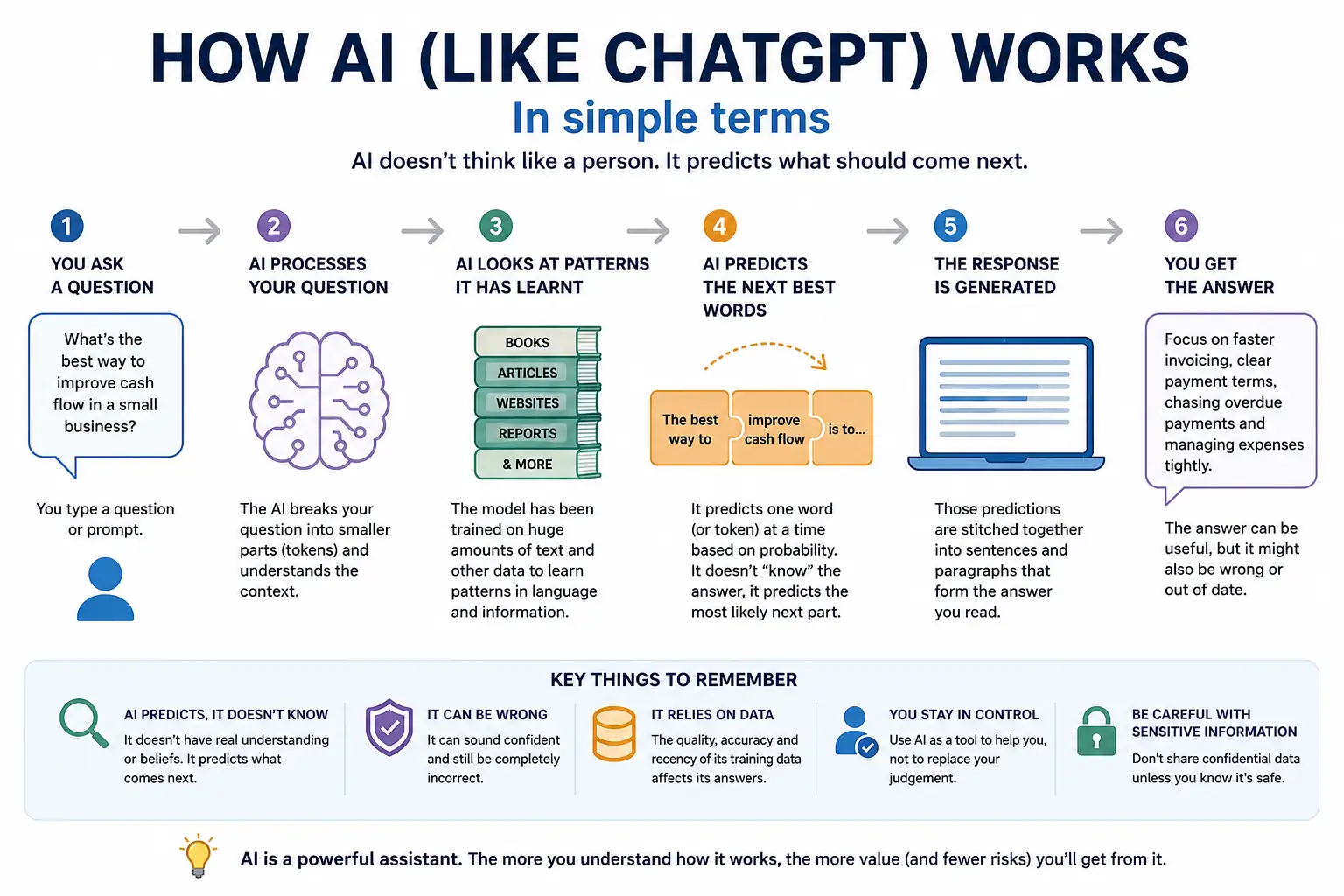
The key thing to understand from this diagram: AI predicts, it doesn’t know.
It doesn’t have real understanding or beliefs. It’s not looking up an answer in a database. It’s predicting, one word at a time, what a plausible answer would look like.
That’s why it can sound confident and still be completely incorrect.
- It relies on data — the quality, accuracy and recency of its training data affects its answers.
- You stay in control — use AI as a tool to help you, not to replace your judgement.
- Be careful with sensitive information — don’t share confidential data unless you know it’s safe.
How do large language models work?
When you type a question, it isn’t looking anything up. It’s predicting, one word at a time, what a plausible answer would look like.
It isn’t answering your question. It’s predicting what a good answer would sound like.
“It isn’t answering your question. It’s predicting what a good answer would sound like.”
That single idea explains almost everything else in this guide. Including why it makes things up.
How to spot generated text before you publish it
Read it out loud. Generated text often has a “smoothed-out” quality: correct grammar, confident tone, but vague on specifics. If a paragraph could apply to any business in any town, it hasn’t actually been checked against yours. Add a real detail only you’d know, and check every fact yourself before it goes anywhere near a customer.
Why does AI make things up? (Hallucinations explained)
AI makes things up. It’s not a bug. It’s a feature of how the technology works.
The technical term is hallucination. It means the AI generates information that sounds plausible but isn’t true.
Why does this happen? Because the AI is optimised for plausibility, not truth. It’s trying to produce text that looks correct, not text that is correct.
Remember: it’s predicting language, not retrieving facts.
Imagine asking a junior employee to write a report on a topic they know nothing about. They’d do their best to sound knowledgeable, but they’d probably get things wrong. AI does the same thing, but faster and with more confidence.
It isn’t.
That’s the honest answer. It can be right often enough to be genuinely useful, and wrong often enough that checking matters every time.
Imagine a café owner asks an AI tool to write up the calorie content of a new menu item for the board outside. If the model gets the number wrong and it’s published as fact, that’s a real problem under the Food Information Regulations, not just an embarrassing typo. The AI won’t flag its own uncertainty. It’ll write the wrong number with exactly the same confidence as the right one.
Don’t assume AI-generated facts are correct. But don’t assume they’re always wrong either.
Treat every factual claim from an AI tool the way you’d treat a claim from a new, keen, but unqualified junior member of staff: often useful, always worth checking before it goes out the door.
“The AI told me” is never an acceptable excuse.
Where does AI get its information from when you use it?
When you ask an AI a question, where does the answer actually come from?
There are seven main routes. Each one changes how much you should trust the reply.
1. Its training data — the billions of words, images and videos it was built on. It doesn’t search through these when you ask; it uses the patterns it learned. But it has a cut-off date. It doesn’t know anything after that.
2. Live web search — some tools can search the internet in real time. You usually have to turn this on. The AI scans the top results and summarises them. But it doesn’t weigh sources against each other. If the top result is wrong, it will confidently tell you wrong information. It doesn’t fact-check.
3. Your own data — you can upload spreadsheets, PDFs, contracts, accounts, photos. This is where AI becomes genuinely useful for your specific business. It can analyse your numbers, summarise your contracts. But this is also where most business owners get caught out. Free tools often use your inputs to improve their systems. That’s fine for a general question. It’s not fine for your profit-and-loss statement, your employee list, or your customer database.
4. Images you give it — photos, screenshots, handwritten notes. It reads them using pattern-matching. It can misread handwriting or miss context. Treat it as a rough transcription, not a faithful copy.
5. Your conversation history — the questions it has already asked you, and the answers you’ve given. It uses this to tailor later responses. But that history disappears when the chat ends, unless the tool saves it.
6. System instructions — hidden rules that shape its personality. “Be helpful.” “Don’t give legal advice.” “Answer in British English.” You don’t see these, but they influence every reply.
7. Connected apps — APIs connected to your accounting software, CRM, or email. This is the riskiest route because it gives the AI ongoing access to your live business systems. Most small businesses don’t need this yet.
The one-minute privacy check
Before you upload or paste anything, ask yourself: is this information I’d be happy to share with a stranger? If the answer is no, don’t put it into a free AI tool. If you genuinely need AI to work with that data, pay for a business version and read its data policy carefully.
“Only upload information you’d be comfortable with the provider keeping.”
Chatbots explained
A chatbot is the interface you type into. An LLM is the engine underneath.
Think of it like this: the chatbot is the car. The LLM is the engine. You don’t drive the engine directly — you sit in the car, turn the wheel, press the pedals.
Not every chatbot uses an LLM. Some are just menus disguised as conversation. An LLM-powered chatbot can handle open-ended questions. But it can also confidently say something wrong.
Don’t buy a chatbot without knowing which one you’re getting.
“The chatbot is the car. The LLM is the engine.”
Where does training data come from?
AI models are trained on massive collections of publicly available information scraped from the internet: websites, books, academic papers, code repositories, forums like Reddit and Quora, and image and video collections.
Major datasets include Common Crawl, The Pile, C4, and ImageNet.
The legal position on copyright is not settled. In the UK, the Government has consulted on the issue but firm legislation hasn’t been enacted. The law may change.
Don’t assume the legal questions around AI training data are settled. They aren’t.
If you’re generating content for commercial use, be aware that the AI’s training data may include copyrighted material. Check your terms of service.
Does AI think like a person?
The short answer is no — but it performs something that looks like thinking.
When you ask a person a question, they draw on understanding, experience and reasoning. They know what they don’t know. They can say “I’m not sure.”
AI doesn’t do any of that.
AI “reasons” by following statistical patterns in language. When you ask it a complex question, it breaks the problem down into steps — a technique called chain-of-thought reasoning. It generates intermediate thoughts before arriving at an answer, much like you might work through a problem on paper.
But here’s the crucial difference: you understand why each step makes sense. The AI doesn’t. It’s following a statistical path that looks like reasoning because it has seen similar paths in its training data.
It doesn’t know what it doesn’t know.
This is where the human comparison breaks down completely. When you don’t know something, you’re aware of your uncertainty. You can say “I don’t know” or “I’m not sure.”
AI has no such awareness. It produces an answer with the same confidence whether it’s certain or guessing. That’s why it can confidently tell you something completely false.
In 2026, researchers can now peer inside AI models as they work. Anthropic developed a technique called the “J-lens” that reveals a hidden internal workspace inside their Claude models — a small zone of activity where the model holds concepts it can reason with. This workspace “emerged on its own during training” and mirrors some features of how human conscious thought works.
But mirroring how something works isn’t the same as being it. As one neuroscientist put it: “Intelligence requires no such feeling. A system can solve a problem without experiencing the act of solving it.”
The AI can reason through a problem. It doesn’t feel itself doing it.
The bottom line: AI is an incredible mimic. It can produce answers that look like they came from a thoughtful person. But it’s not thinking. It’s predicting.
“Intelligence requires no feeling. A system can solve a problem without experiencing the act of solving it.”
What level of understanding does AI have?
In UK education terms:
- GCSE — AI breezes through this. Vast knowledge, shallow understanding.
- A-Level — Performs well on structured answers. Struggles with original thinking.
- Undergraduate — Can produce passable essays. Lacks depth and original thought.
- Postgraduate / expert — Falls short on real expert work that requires professional judgment.
AI is like a brilliant student who has read every textbook but never done a single practical. It knows the theory. It has never actually done the work.
“AI is like a brilliant student who has read every textbook but never done a single practical.”
Generative vs agentic AI
Generative AI produces something for you to look at. You ask, it answers. The decision stays with you.
Agentic AI goes further. It can take a goal and work through the steps itself — check the accounts, draft the emails, send them.
That difference matters. A generative tool that gets something wrong gives you a bad draft. An agentic tool that gets something wrong might actually send it, book it, or delete it.
Before you give AI the ability to act, not just answer
Ask exactly what it can do without a human checking first. If the answer is “quite a lot”, make sure there’s a step where a person reviews the output first.
Can you trust what AI tells you?
Sometimes. Not always. And it won’t tell you which.
This is called hallucination. The model produces something fluent and confident that isn’t true. It doesn’t know the difference between a fact and a plausible-sounding sentence.
It isn’t.
That’s the honest answer. It can be right often enough to be genuinely useful, and wrong often enough that checking matters every time.
Treat every factual claim from an AI tool the way you’d treat a claim from a new, keen, but unqualified junior member of staff: often useful, always worth checking before it goes out the door.
“The AI told me” is never an acceptable excuse.
What AI is genuinely good for
Generative AI is genuinely useful for a narrower set of jobs than the marketing suggests:
- First drafts — job adverts, social media posts, customer emails that you then edit
- Summarising — turning long documents or meeting transcripts into short summaries
- Explaining — contract clauses, tax terms, technical specs in plain English
- Brainstorming — generating options you wouldn’t have thought of
- Structuring — turning messy lists into organised tables or plans
What AI still gets wrong:
- Anything that needs to be factually exact — prices, legal terms, numbers that matter
- Anything that depends on context it doesn’t have — your customers, your suppliers, your history
- Judgement calls with real consequences — refunding a customer, handling a complaint
The five rules I’d start with
- Know what you’re asking. Be specific. “Help with marketing” is vague. “Give me five ideas for a Facebook post aimed at local customers” is clear.
- Don’t assume the answer is true. If the information matters, check it.
- Be careful with business information. Understand what the tool does with it before you upload anything.
- Keep people involved where mistakes matter. The higher the consequence, the more human judgement you need.
- Start small. Pick one task. Try it. Measure whether it saves you time.
When not to use AI
Sometimes the best decision is not to use AI.
Don’t use AI when:
- The information is too important to get wrong
- The decision affects someone’s welfare or rights
- You don’t have time to verify the output
- The tool doesn’t tell you what it does with your data
- You’re not sure whether it’s appropriate
Using AI because competitors are using it isn’t a good reason. Use it because it genuinely helps your business. And if it doesn’t, don’t.
“The useful question isn’t ‘Can AI do this?’ It’s ‘Should I let AI do this?'”
AI FAQs
Got questions about AI? Here are the answers.
These are the questions UK small business owners ask most often about AI.
Is ChatGPT the same as “AI”?
No. ChatGPT is one product built on a large language model. “AI” covers a much wider range of technology.
What’s the difference between ChatGPT and an LLM?
ChatGPT is a chatbot—the interface you type into. An LLM is the engine underneath. ChatGPT uses an LLM, but they’re not the same thing.
Can AI think like a person?
Not in the ordinary human sense. AI can perform tasks that look like reasoning, but you shouldn’t assume it has human understanding, judgement or responsibility. It’s predicting language, not thinking.
Why does AI make things up?
Because generating a plausible response isn’t the same as checking whether that response is true. Language models can produce confident but false information. This is called hallucination.
Can I use ChatGPT with customer information?
Probably not unless you’re using a business version with clear data protection guarantees. Free versions often use your inputs to improve their models.
Is AI trained on images as well as text?
Increasingly, yes. Many modern AI models are multimodal — trained on text, images, audio, and video.
Will AI replace my staff?
For most small businesses, the evidence so far doesn’t support that. Most firms using AI report no change to headcount. It tends to change how a job is done rather than remove it.
How do I know if an AI answer is correct?
Treat it the same way you’d treat advice from someone you don’t know well: plausible until checked. Verify anything factual against a source you trust.
Sources
-
UK Government — Artificial Intelligence Playbook for the UK Government
★★★★★
UK Government
Practical UK framework covering AI capabilities, limitations, security, human control and responsible use. -
UK Government — Consultation on copyright and AI
★★★★★
UK Government
Current UK Government position on copyright and AI training data, noting that legislation has not yet been enacted. -
Information Commissioner’s Office — Guidance on AI and data protection
★★★★★
UK Regulator
The ICO’s core guidance on how UK GDPR applies to AI systems. -
BenchLM — Best LLMs for Reasoning — July 2026 Leaderboard
★★★★☆
Benchmark Platform
Current, verified data on AI reasoning performance including ARC-AGI-2 and GPQA Diamond. -
IBM — What Are Large Language Models?
★★★★☆
Technology company
Clear explanation of how LLMs are trained and generate text. -
Communications Psychology — Understanding large language models demands distinguishing human projection from machine cognition
★★★★½
Academic Research
Examines the difference between human reasoning and LLM processing. -
Office for National Statistics — Artificial intelligence in UK businesses: 2023 to 2026
★★★★★
Official UK Source
Official government data on AI adoption among UK businesses.
⚠️ Evidence note: The claims about AI benchmark performance (ARC-AGI-2, GPQA Diamond, IQ scores) are based on published leaderboard data from July–August 2026. The comparisons to UK education levels are interpretive analogies, not formal assessments.
The legal position on copyright and AI training data is unsettled and may change. The guidance on data protection reflects ICO principles but is not legal advice. Providers’ data-handling practices change frequently — always check a tool’s current terms.
Start with one thing
You don’t need to overhaul how your business works this week.
Pick one low-stakes task. Something where a mistake would be mildly annoying rather than genuinely costly. Try an AI tool on that first.
Check what it produces against what you already know. Notice where it helps and where it falls short.
That’s a better foundation for deciding what AI is actually worth to your business than any amount of reading about it.
Better AI Decisions is a free, independent resource. We’re not trying to convince you to use more AI. We’re trying to help you use it where it actually earns its place — and skip it where it doesn’t.
Explore more practical guidance →